Friday, May 8, 2009

a poem for summer

Here's a poem of mine to celebrate the imminent arrival of another summer.  Try reading it aloud, and slowly.  After all, summer is a time to slow down, to cool our jets, to savor the moment.

“Melon”

Two men on a porch,
old friends, old friends,
fifty years and more,
in a town left far behind,
taking it slow and easy,
making it last.

“What’s your hurry?”
one of them asks
as I walk by,
my usual pace,
on my way
to someplace else.

“Come on up,”
he says with a wave,
his hand flowing smooth
through the summer air,
drawing me in,
right up the walk.

“You’re one of those
burnin’ daylight men,
aren’t you?” And I laugh.
”Not much daylight left,”
he says, “not much to burn,
I reckon.”

“I guess not,” I say.
“Come have some melon then,
here’s a chair,
cool your jets,
as my grandkids say.”
I smile and nod, my jets cooling down.

“Charley,” he says,
and his friend looks up,
melon juice on his lips.
”What?” Charley says.
”Cut the man some melon,
that’s what.”

“OK, Al,” Charley says,
and he takes the knife,
small and beat up but sharp,
the world’s best surgeon at work,
the honeydew his patient,
its life in his skilled, weathered hands.

He cuts a generous slice,
holds it before me
like the magi’s gift,
for me, a stranger
on their ancient porch,
and waits for me to taste.

There are no plates, no forks,
no napkins, nothing but
the melon and the three of us.
They watch me bring it to my mouth,
the light green sweetness on my tongue,
and me humming as they smile.

“Good melon,” Al says.
“The best,” Charley replies.
I cannot speak, only hum,
the melon possessing me,
the chair my home,
the porch my world.

“You never had melon
like that before,”
Al says, and he licks his lips,
and Charley cuts me another slice
and one for Al
and one for himself.

And so it goes,
as the daylight fades,
and there we are
between day and night,
and I have traded
one journey for another.

By the time the fireflies
light the yard
another melon has appeared,
larger and sweeter than the first,
and Charley hands me the knife
and tells me all his surgeon tricks.

“Good melon,” Al says.
“The best,” Charley replies.
And then they sit back,
the melon endless like this day,
and close their eyes
and listen to me hum some more.


Saturday, April 25, 2009

take five

"Take Five” is many things, from the title of a classic jazz piece—composed by saxophonist Paul Desmond and made famous by Desmond and the Dave Brubeck Quartet as the first jazz instrumental to sell a million copies—to, on a much smaller stage, the title of a column that I write for Words of Paradise, the newsletter of the Aloha chapter of Romance Writers of America.

The phrase, as we shall soon see, also has meaning for writers, God bless them and their smoking keyboards.  Why are those keyboards smoking?  Maybe it’s because their masters are hot and heavy into yet another rewrite, perhaps the fifth rewrite. Maybe it’s “take five” because the first take, the first draft, was a start but only that, and now it’s months later and you’re in the middle of a fifth draft, and you could have listened to the Brubeck piece a million times until it was stuck in your head for all eternity, and you could have learned to play the piano and mastered the 5/4 time of “Take Five,” but you didn’t because you’re lost in yet another draft of yet another story.  Don’t get me wrong, I love writing.  It’s in my blood and bones.

“Take five,” of course, is simply a way of saying “take a break.”  Take five minutes and then come back.  The original Brubeck recording of “Take Five” lasts five minutes.  It’s as cool as Desmond’s sax, and the seldom heard lyrics, composed by Brubeck and his wife Iola, open with these cool lines:  “Won’t you stop and take a little time out with me, just take five; Stop your busy day and take the time out to see I’m alive.”

To take five, then, is to take a little time out from your day to do something vital but often overlooked.  

I usually think of time management in terms of hours, thinking “here’s what I can accomplish in the next hour,” beginning when the big hand is on the 12.  We get 24 of those each day.  

Looking at my watch, however, when I see all the numbers that mark the big hand’s hourly journey, beginning with one, I begin to see time in five-minute segments.  “Here,” time says, “take five.”   Then five minutes later, time says, “Take five more.”  It’s as if time tosses us a nickel tip, and then feels a bit cheap and returns to the table to toss us another nickel.  But time keeps on tipping.  The nickels keep landing on our table.

What can we do in five minutes, besides listen to “Take Five” or take a short break from whatever we’re in the middle of at the moment?  Here’s a short list.  Just one list of many.  Feel free to make your own.

1. Dream.
2. Dream some more.
3. Write down the dream, as a story title.
4. Give the dream to a character.
5. Write to find out what happens to the dream.

That’s five nickels, 25 minutes.  That last five minutes will be just a start, of course.  The big hand makes one circle, then another, and another.  Three hours later the story is all you can think of.  It will be there the next day, waiting for you to follow it down the winding road of dreams.  When you’re done, take five.  You’ve earned it.

Tuesday, April 14, 2009

does romance have a chance?

So there I was last Sunday, watching the final day of the Masters golf tournament. April in Georgia. Hypnotic just to take in the beauty of Augusta—its fame well deserved, unrivalled among golf courses, except perhaps for that part of Pebble Beach that runs alongside the mighty Pacific.  All that green, green grass, the azaleas, the water, the classic stone bridges, the white bunkers, the tall trees.  Ah yes, so relaxing to sit back in a recliner, with a cool drink in hand, and observe spring in Augusta. Listening to the soft music of birds in the pines.

It’s all perfect. But then they put the golfers on the course and give them clubs and little white balls to try to hit down those long fairways and onto the emerald greens, and see who can get home with the fewest number of strokes.  Without having a stroke, because it’s not so relaxing for the golfers. Especially if it’s late on a Sunday and you’re in a three-way playoff and you’ve already been through the wringer trying to get home on the back nine without totally falling apart.  Especially if you’re Angel Cabrera and you’ve taken the scenic route with your tee shot on 18, the first playoff hole. Kenny Perry and Chad Campbell are both sitting pretty in the fairway, but you’re off in the woods, and your ball has come to rest behind one of those tall pines and there’s no way out, you’re toast, and the gods of Augusta have laughed at you and gone off to ride to glory with the other two guys. 

You have no chance. All that work for four days, outplaying Tiger and Lefty, the two best golfers in the world, and now you’re behind a tree. Everyone expects you to just pitch out into the fairway, but you’re looking into the woods.  More trees.  You can’t be serious.  What’s your plan, to say a prayer and try to get through those trees and on up the fairway?  

Spectators have scattered.  Make way for the crazy man!  Angel is like a man suddenly lost and looking for a miracle.  What is he thinking? Nothing to lose?  He stands next to the tree, plants his feet, and prepares his club for the Hail Mary.  I hold my breath.  He brings the club down hard on the ball and it flies away.  Then we hear the sound of golf ball on wood.  He’s hit a tree.  His next shot, no doubt, will be from another zip code; is that the 10th hole on the other side of the woods? The camera zooms in on Angel’s face.  His eyes are big.  What has happened? Has his prayer been answered?

And then the camera spots the little white ball in the green fairway, its journey through the woods over now, and it’s in the 18th fairway, and the gods have laughed at Angel and given him a break. Maybe they will let him scramble in on this first playoff hole just to see what happens.  What happens is that Perry and Campbell have trouble hitting the green.  Angel, however, having seen the tall pines up close and personal, having emerged from the woods a wild man but somehow blessed by the gods, proceeds to show the other two guys how to finish a hole. He scrambles to make par.  Campbell misses his par putt and is eliminated.  Perry and Angel head for the second playoff hole, and the gods—having seen something they like from the Argentinian they call El Pato, the Duck—ride with Angel Cabrera to glory and the Masters championship.  "Here," the gods whisper in his ear, "have a green jacket."

Quite a ride.  An amazing Masters finish.  Tiger and Lefty, playing together and attracting huge galleries, charging all day to catch the leaders and coming up just short.  Then three mortals, underdogs like the rest of the world to Tiger Woods, battling down the stretch.  And on that first playoff hole, lost in the pines, his hopes apparently shattered, at that moment the biggest underdog of all, Cabrera going for an improbable, desperate shot, and taking us all with him on an unlikely finish.

I watch as they replay that shot.  Again he attempts the impossible.  Does Angel have a chance? You’d have to be a little wild and crazy yourself to bet on him at that point, although the odds would be tempting.  

Why do I think of that moment as romantic?  Maybe because there’s something wonderfully romantic about challenging the gods, shunning the safe, logical path, and opening a window for luck.  Sports fans for ages have cheered on the underdog.  We love unlikely happy endings. Does romance have a chance? Sometimes. There are so many obstacles in its way.  Maybe it’s a game for underdogs.  Maybe the gods smile on us when we dare to be a little wild and crazy.  Just a lesson I learned last Sunday watching an Angel.

Monday, March 9, 2009

dining alfresco ... in two takes

The following is in response to the writing challenge in my February 4th blog on hearing voices.  

Take One: 

Again with the menu. He always orders. He has impeccable taste. We always sit at this table. He tips the maitre d’ (which is short for maitre d’hotel, a fact of which he reminds me periodically, as if I need reminding). He always sits facing the view, and I sit facing the other people, which is fine with me because I want to study the other people. Occasionally I study him, but not for long. He oozes predictability. You could call it stability, or dependability, but what I see oozing from him is predictability.

We are dining alfresco, and naturally he reminds me from time to time that in the 16th century alfresco meant “in a cool place.” It is cool out here, on the patio. “In Hawaii,” he reminds me, “we would call it a lanai.” Well, yes, we would, if we were in Hawaii, which we are not, and never will be. Couples go there on their honeymoons, or anniversary trips. I don’t see a lanai in our future, no honeymoon, but ... perhaps, just maybe, an anniversary. 

One day we will be at sitting at this table, much as we sit now, the candle the same, the buildings the same, the stars the same, and he will put down the menu and remind me that this is an important day in our relationship, the third anniversary of our first date, at this very restaurant, where we sat at this very table. Yes, and he first ordered my dinner, and I first studied him carefully. Yes, he will proclaim, a little too grandly, our third anniversary, and I will gasp. He will take this gasp as a sign of delight, of approval, but he will be wrong. His judgment, unlike his taste, is not impeccable. I study the candle. Dining by candlelight, how romantic. Perfect for a first date, a time when all the bright illusions and hopes of a new relationship float above our heads like small balloons that believe they will live forever.

Do not misunderstand me. I am not complaining. But one day I will simply say no. No, thank you, you are kind to ask, but I cannot accept. I will not dine alfresco with you again, or watch you tip the maitre d’, or watch you study the menu. Au revoir, I will say, and remind him that it’s what they say in France, or if we were in Spain I would tell him adios, or in Italy arrivederci, or in England cheerio, or in Japan sayonara, but we will be in America, where “so long” works just fine. And then I will be strangely sad for a while. And I will miss the lobster bisque.

Take Two: 

I like a man who takes charge. He tells me the lobster bisque is excellent here, and I say fine. He seems to have impeccable taste. I like how he tipped the head waiter (he called him the maitre d’, which he said is short for maitre d’hotel) so we could have this wonderful table under the stars. 

Then he tells me that he has just ended a long relationship with a woman who suddenly said goodbye one day. He chose not to ask her to stay. So I lean over and pat his hand (and notice that he has a really good manicure), and I tell him that when God closes a door he opens a window. Then I turn to look at the stars, and show him my profile, which is quite good I am told. 

Then I ask him if he has ever been to Hawaii, or if he wanted to go some day, and if we closed our eyes we could imagine that there were tiki torches everywhere, and Hawaiian music, and wouldn’t that be wonderful. And then I sit back and let him talk some more, and he tells me that we are dining alfresco, and what that meant in the 16th century, and I am like so impressed.

Wednesday, February 4, 2009

hearing voices

Lately I’ve been hearing voices.  Again.  Voices in my head.  But don’t get nervous.  The voices aren’t telling me to do bad things.  They’re just talking to themselves, or having conversations, and that’s absolutely a good thing.  If you write fiction, telling stories that need to be true but need not be factual, you want characters in those stories.  You want your characters to talk to each other, so they might as well talk in your head.  I draw the line at talking back to these characters, however, especially in public.

On March 7, at the RWA Aloha Chapter meeting, I will be leading a fiction writers workshop on voice. We will be looking at the writer’s voice, the narrator’s voice, and the character’s voice. How do they differ?  Do they ever overlap?  And how do you find your voice?  It’s probably not something you lost, but rather something you discover over time.  Years, in fact.

The workshop will include a special section on book design with graphic artist Stephanie Chang, who will talk about imagining your book and matching design with voice.  Stephanie and I have been working on the design for my contemporary romance
Chasing Cowboys.

If you’re looking for a homework assignment, here’s one.  Imagine a  young man and a young woman seated at a table.  The man appears to be studying a menu. The woman doesn’t have a menu.  Is she talking?  What is she thinking?  There’s a lighted candle on the table, buildings in the background, and stars in the night sky.  A romantic setting.  So what’s missing?  We need voices! Make them talk.  You have the characters and the setting. Now write the scene.  Give them distinct voices.  Give each an agenda perhaps; decide what it is each one wants.  First date?  Last date? Is there trouble ahead, trouble behind?  

In addition to the dialogue, decide on a narrator for this scene.  You can  go with a third-person narrator, or you may choose one of the two characters to be a first-person narrator.  

Finally, try to give the scene these three things:  (1) a tantalizing beginning, in the voice of the narrator or one of the characters, perhaps introducing some conflict or tension;  (2) a middle in which the characters learn something or change in some way; and (3) a strong ending, a definite resolution.  Don’t leave your reader hanging!
 
When your scene is written, test it.  Read the scene aloud.  Try reading all the lines of one character, then go back and read all the lines of the other character.  This is your chance to fantasize about how the stage and screen lost a great actor the day you decided to become a writer instead.  “And the Oscar goes to ...” 

Then wake up and rewrite your scene. At some point in this process, listen to your own voice as you tell yourself that you are one creative genius.  Just make sure that nobody’s around when you start talking to yourself.


Friday, January 30, 2009

Ratatouille and the creative process

If you saw the Pixar animated film Ratatouille, about a rat who wants to be a chef in Paris, you’ve witnessed a shining example of creativity, one that filmmakers, cooks, and even writers can learn much from.  In particular, one of the bonus features on the DVD is a 13-minute behind-the-scenes documentary, “Fine Food & Film,” a conversation with director Brad Bird and chef Thomas Keller.  

Producer Brad Lewis, who worked with both men on Ratatouille, introduces the documentary by talking about the similarities between the acclaimed filmmaker and one of America’s great chefs:  “When you see these guys work you start to see a similar not only sparkle in their eye, and how they do what they do, but also they’re really intense, they’ve got this attention to detail, and they’re very passionate about their work.  So one’s about cooking, and one’s about making great movies, but there is this harmonic in their approach.”

As we see Keller at work in his restaurant kitchen, he begins by saying, “Anybody can cook.  It’s just you have to have the desire, the determination to make something that you’re going to feel proud to give to somebody, and that emotional connection with somebody.  I think you have to be emotionally attached to what you’re doing, and certainly, with food, it’s very easy because it’s something that nurtures.”  Bird the filmmaker seconds this appeal to emotion: “You’re constantly trying to get the audience into the state of feeling and how things feel, rather than how things are.”

On the origin of creative ideas, Bird says, “Every idea comes about in its own way.  I had an idea for a film that started with me hearing a song and thinking it was another song.”  Keller tells the story behind one of his imaginative dishes, Oysters and Pearls: “Walking down the aisle of a grocery store and seeing a purple box of pearl tapioca, and you see a word that says ‘pearls’ and you associate that with an oyster.  And then what comes from that is a dish .”

Bird says that he plays a game familiar to fiction writers, the what-if game: “Other things come out of just a thought that you have, of ‘What if?’  Or ‘Superheroes must feel defeated sometimes.’”  Keller begins with the food: “And the food can be so inspiring.  It comes in in its raw form.  You think, ‘Okay what am I going to do with this?’”

Brad Bird talks about the creative state of mind, which is another familiar topic for writers:  “The mistake that a lot of people make is thinking that you can force ideas to come.  You can’t really.  All that you can do is observe what kind of environment puts you in a creative state of mind and then try to create that environment.”

Bird and Keller both strive for spontaneity.  In talking about animation, Bird touches on a quality that writers strive for in their storytelling:  “It’s not a spontaneous act, but if you do it artfully, you get the feeling of spontaneous thought.  If you do it well, it will feel spontaneous.”

Filmmaker and chef both praise their mentors, and stress the importance of having a mentor as you are learning your craft.  Keller’s mentor was Roland Henin, a chef whom he met in the early ‘70s, in a private club in Rhode Island where Keller was working.  Keller says, “And he made me understand that there was an emotional connection, and that I was actually cooking for somebody in a way that brought them pleasure.”  Bird’s mentor was Milt Kahl, a great animator at Disney: “And he was tough.  He was tough.  He did it in a nice way, he wasn’t cruel to me, but he let me know absolutely where I was coming up short.”

At the end of the conversation, Bird touches on the question of audience, and the point that the first audience is the filmmaker:  “If you think about what you’re doing logically, you are trying to invent what an audience that you likely will never meet will enjoy two years from now.  But you can’t think of it that way.  You have to think about it in terms of, ‘What do I want to see?  What delights me?’  So I think that you’ve got to make something that pleases you and hope that other people feel the same way.”  

Good advice there for all artists, I believe, including writers.  When I write a story, I am the first reader, and I want to make myself smile, and laugh, and, at times, feel sad.  If I feel a tear on my cheek when I’m at the keyboard, I know I’ve made that emotional connection with the characters in the story.  The story is a new dish that I want others to taste.  I fuss over it and tweak the ingredients and think about presentation and then plate the dish.  I am like Remy, the ambitious young rat in Ratatouille, living to create something new and exciting.

Monday, January 19, 2009

this land is your land

On the eve of a watershed moment in our country's history, 24 hours before Barack Obama takes the oath of office, I awoke this morning thinking of Woody Guthrie.  

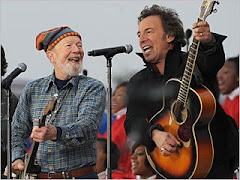
A young man from Okemah, Oklahoma, who had roamed and rambled through the country in the '30s with his guitar, Woody wrote a song in 1940 that's right up there with "America the Beautiful."  Pete Seeger and Bruce Springsteen sang Woody's song at the Lincoln Memorial yesterday. Close your eyes and imagine you're hearing the words for the first time.  Now imagine it's 1940 and it's Woody Guthrie's voice and guitar.  The song begins with its refrain:

This land is your land, this land is my land
From California, to the New York Island
From the redwood forest to the gulf stream waters
This land was made for you and me


Each verse answers an unspoken question.  Each verse takes us with Woody on his journey through America.
As I was walking a ribbon of highway
I saw above me and endless skyway
I saw below me a golden valley
This land was made for you and me
And then there's that voice that Woody sang about, a voice that appears in most of the verses:
I've roamed and rambled and I've followed my footsteps
To the sparkling sands of her diamond deserts
And all around me a voice was sounding
This land was made for you and me
The sun came shining as I was strolling
And the wheat fields waving and the dust clouds rolling
A voice was chanting as the fog was lifting
This land was made for you and me
Like "American the Beautiful," with its purple mountains and amber waves of grain, Woody's song gives us enduring images of our land. The "dust clouds" remind us that Woody traveled with the migrant workers who fled from the Dust Bowl of the '30s.  The last verse, however, is set in the city, amid the unemployment and doubt of the Great Depression:
In the square of the city - In the shadow of the steeple
Near the relief office - I see my people
And some are grumblin' and some are wonderin'
If this land's still made for you and me.

The song doesn't end there, however, because the last verse is followed by the great refrain, sung twice this time, or as many times as we like. We can just keep singing that refrain until our voices give out and we have to get some work done.  
This land is your land, this land is my land
From California, to the New York Island
From the redwood forest to the gulf stream waters
This land was made for you and me

I hear that in his speech tomorrow Barack is going to ask us all to get to work.  The song will still be there, of course, the day after tomorrow, and the day after that, and as long as we keep singing it, or hearing it in our heads.  And if the tune gets stuck there, well, there are a lot worse songs to be playing over and over.
Woody got it right.  "This land's still made for you and me."  I believe that America belongs to those who love it, to those who treasure its beauty, to those who roll up their sleeves and work to make it better.