Wednesday, September 23, 2009

HawaiiReaders.com, a new site for readers and writers

It's alive! The Honolulu Advertiser's new website, HawaiiReaders.com, is out of the laboratory today and walking about in the Internet world. The new site (http://www.hawaiireaders.com/) provides a great opportunity for Hawaii's readers and writers to interact.

In addition to news from local publishers, reviews, and an events calendar, the site has four writer's blogs, including mine, "A Little Romance." I will be posting on romance fiction every Monday, Wednesday, and Friday. I see this as a great opportunity to promote Hawaii's literature and Hawaii's writers, to explore the always intriguing world of romance fiction, and to interact with readers by way of the site's comments and discussion features.

My topics this week are "Anticipation" and, on Friday, "How much romance can you handle?" (featuring responses to that question from some members of the Aloha Chapter, Romance Writers of America).

In the coming weeks I plan to write on a wide range of topics, including:

1. Romantic vampires (is it socially acceptable to bite and drink on the first date? ... with a guide to the Twilight series from Cami Nihipali ... thank you, Cami!).

2. Romance in tough times (why does romance sell even more in hard economic times?)

3. Earning the happy ending (why do lovers have to go through hell to get to heaven?)

4. Read the book, see the movie (a look at a few classics: Gone With the Wind, Wuthering Heights, Pride and Prejudice)

5. Feeding the Romance (What makes a good romantic dinner? Do romantic characters stop to eat?)

6. Designing Woman (an interview with Stephanie Chang on book design)

7. Local romance in Lee Cataluna's Folks You Meet in Longs

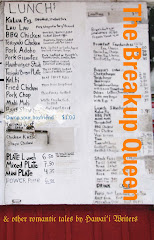
8. Romance with an edge: The Breakup Queen

9. Judging romance by its covers (a visit to the the romance shelves at Bestsellers in downtown Honolulu)

This is just a taste. I invite your suggestions and urge your participation! Please leave comments on the blog and join in the discussions, and please start spreading the news to your friends. Check out the book events calendar. If you have something to add to the calendar please let me know.

Mahalo to the Honolulu Advertiser and the Hawaii Book Publishers Association for bringing this new creature to life!


Wednesday, August 19, 2009

is anticipation making you late?

You may be old enough to remember a 1980 commercial for Heinz ketchup that featured Carly Simon in the background singing "Anticipation." Someone held a ketchup bottle upside down and waited, and waited, and waited for the ketchup to ooze out. Message: Heinz is thick, and worth waiting for. You can find the commercial on YouTube. Just search on "Carly Simon ketchup."

Carly Simon's words include "Anticipation, anticipation, is making me late, is keeping me waiting." Making you late? Really? Come on, it's just ketchup. In the commercial anyway.

But what if we use ketchup not as a condiment but as a metaphor? Let's say ... oh, I don't know ... as a metaphor for love and romance. Now there's something that's better than thick ketchup on your fries, although romance is not always waiting for you conveniently in aisle 5 of your favorite supermarket.

Isn't that one of the great features of romance, the anticipation? Whether we're reading romantic fiction, or perhaps chasing romance in our lives (or being chased by it), there are all those delicious moments, hours, and days, when we anticipate the experience: wondering, waiting, finally meeting, wondering some more, flirting with romance until it either runs away or draws us in like a powerful magnet (shifting metaphors here, so hold the ketchup for a second).

We look at the ketchup in the bottle and anticipate its rich sweetness, the way it looks on the fries, the way it will taste on our tongue. If the fries are hot and the ketchup is cool, that's the best.

So which senses do fictional characters use in their romantic journeys? Which senses do we use in ours? All of them. First we see the object of our romantic anticipation ... unless we meet first on the phone, and then it's a voice and we hear. Later there is the first touch, perhaps a handshake (which can reveal so much), first scent (stock up on good soap, and use it often!), and first taste (maybe just a nibble on an earlobe, or a licking of a neck, or the taste of that first kiss on the lips that makes you forget all about ketchup and fries).

And before experiencing these sensations, before you know the sound of her voice or the taste of her lips, there is the anticipation of those sensations. We are creatures of imagination. Before the fireworks begin, the romance is born in our minds. Before the fictional characters light up the pages of a novel, the romance is born in the mind of the writer, and born again in the mind of the reader.

So bring on the fries. Bring on the ketchup. Bring on the romance. As the Heinz commercial reminds us, the taste is worth the wait.


Wednesday, August 12, 2009

low hanging fruit

"Low hanging fruit." Easier to pick. There for the taking. Why venture higher when there's good fruit you don't even need a ladder for, or maybe just a short ladder?

I hear that phrase now and then in different contexts, often from someone on the radio or TV. When they use the familiar phrase do they see the image in the metaphor? Do they see a tree with low hanging fruit, and perhaps someone picking?

When I hear "low hanging fruit," an image of a mango tree immediately flashes in my head. Not just any mango tree, although where I live in Kapahulu/Kaimuki, on the island of Oahu, there are beautiful, fantastic Hayden mango trees on every block. I see a mango tree that is no longer there. It's the large old mango tree that used to grace the front yard of a sturdy Japanese-American home built by the family patriarch and his brothers in the 1940s. I came to know the tree because I had met and quickly married the younger daughter.

After a couple of years on Maui, I moved with my homesick honey to Honolulu, where we found an apartment just a couple doors down from that family home, and the tree whose branches gave shade to the whole front yard. We had moved in January, so I enjoyed watching the fruit develop on the great mango tree. On into the spring I anticipated the day when the first red-yellow-green fruit would be ready to eat.

I already knew how ono the mango would be, sliced and juicy, often served with a scoop of vanilla ice cream. What I didn't know was the whole process of mango picking. One warm Saturday morning my wife invited me to join in the first picking of the season. The older sister was there with her husband and their two kids. The grandparents presided over the ritual--Grandpa perched in the tree and Grandma standing at the command post on the front porch. Bamboo and aluminum poles awaited us, and a child's red wagon to hold the prizes.

The picking began. After standing innocently by as a spectator for a while, I was presented with the longest pole. I gazed into the heavens, trying to see what everyone was pointing at, and there they were, the high mangoes. Now all was made clear, revealed in an instant. My job was to reach the high mangoes. Had the family given the younger daughter (all 4'9" of her) the mission of finding a six-footer for this very day? I was too polite to ask, but I had my suspicions.

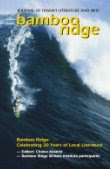
Several years later, when I set out to write my first short story to be set in Hawaii, I chose to tell the story of that experience, the mango picking, told from the first-person point of view of the unsuspecting Caucasian man who had married into the short Japanese-American family and then waited two years before moving from Maui to Oahu to fulfill his destiny as the picker of the high mangoes on that magnificent family tree. The result was "Mango Lessons," a story published later on by Bamboo Ridge Press.

Low hanging fruit? Don't talk to me about low hanging fruit. I believe we need to aspire to something higher. Something more difficult, but ultimately more rewarding. That ancient tree still lives in the pages of a book, in the words of a story that reminds me of the long strange trip I took in my life from Texas to Seattle to Maui, and ultimately to my island home on Oahu, where in my mind's eye I can still see the family gathered around the great tree, pointing to the large beauties waiting in the high branches. Someone else can take the low hanging fruit. Hand me the long bamboo pole.


Thursday, July 30, 2009

yellow brick road

Apart from the everyday world that I walk around in, there's another world I enter when I'm writing a new story. It's like a dream world because it has elements of my everyday world, but transformed somewhere in my mind into something strange and new. How strange varies from story to story.

In this dreamlike world, I quite willingly suspend my disbelief, and trust that most readers will be willing to do the same. Samuel Taylor Coleridge, the Rime of the Ancient Mariner guy, was the one who came up with "willing suspension of disbelief" as a necessity in the dream world of storytelling. In return for entertainment—a good story—the reader agrees to accept some fantastic elements in the story.

The storyteller must do the same, plunging headlong into the dream world, believing the story as it unfolds, taking a path less travelled and unpredictable, if only to see what's around the next bend in the road. Like Dorothy on the yellow brick road, for us the most important step is the first. All the adventures await her, and she must follow that famous path if she is find her way home. The writer, and reader, take that first step on the opening page of a story. Adventures await us, and we know that 15 or 20 pages later, or maybe 400 pages later, we will find our way home to the story's end. The end of the dream, the return to our waking world.

So let's think of that first page of the story as a first step on a journey. Everyone talks and writes about an opening page as a hook, and it is in a way, but that word has always had a sneaky, aggressive connotation for me. I imagine a writer in a long black cape skulking behind an innocent bookshop customer who has picked up a book and is seconds away from feeling a cold, heavy hook around her neck. Her only escape from the sinister hook is to buy the book and leave the store, thus freeing the writer to stalk his next victim.

How much better would it be to imagine the writer standing next to the reader, no weapon in hand, just browsing the shelves, then pointing down the yellow brick road of his story and inviting the reader to join him on the journey?

So here I am, having just finished dreaming, and writing, a short story about a young woman in Honolulu who is totally ruled by her emotions. I call it "The Manic Monday of Orchid Lefleur." This is a working title, but I doubt I will change it. Here's the opening page of that story (please don't call it the hook). This is my invitation to the reader to take that first step on the yellow brick road of this new story, to see what scarecrows and tin men and cowardly lions are waiting to befriend Orchid, what witches and flying monkeys are just around the next bend to threaten her, what poppy fields may delay her jouney home, and what great and powerful wizards live at the end of that road to give us all a happy ending. And so, gentle reader, I give you . . . Orchid Lefleur.

Orchid Lefleur—her real name—awoke on a warm Monday morning in the middle of the Pacific Ocean. On an island, that is. On Oahu, in fact, in the single bed with the amazing Technicolor dream quilt she had bought at the Aloha Stadium swap meet, the one that perfectly matched her colorful inner life, for Orchid was a young woman who was ruled, as they say, by her emotions.

And yet who could have foreseen that this particular Monday would bring all the rainbow colors to the surface, as if Roy G. Biv himself had climbed through the window into Orchid’s bedroom during the night and shone his red-orange-yellow-green-blue-indigo-violet rainbow self on her like some blinding psychedelic spotlight? Who could have foreseen it?

Not Faith Lefleur, her mother, the sweet Japanese-American lady who had done such a splendid job of raising the older daughter but somehow failed miserably with Orchid.

Not Henri Lefleur, the blustery, hockey-mad French Canadian from Montreal who had met Faith at the University of Hawaii when they were undergraduates and were both immediately attracted because each was so exotic to the other.

Not Lilly Lefleur, the older sister, the refined daughter who had her emotions under tight control and was carving out quite a career for herself in finance, currently the teller with the most seniority at her American Savings Branch in Kaimuki. (Lilly—just a side note here—would have been named Guy Lefleur, after Henri’s favorite hockey star, had not her mother insisted on a more feminine name. Some might say that a young woman with the name Lilly Lefleur was destined to become a porn star, or at least dance around a pole on Keeaumoku Street, but they would be wrong.)

Not Brad Pitzer, Orchid’s lingering-but-not-for-long boyfriend, who knew all about her emotions, first hand. Some said that Brad did not resemble the better known Brad Pitt enough to be worth the emotional investment of a long-term relationship, an opinion Orchid was beginning to share.

Not Deena-Anne Tamashiro, Orchid’s best friend since high school who was interested in Brad and had agreed to take him off Orchid’s hands. Orchid had second thoughts, however, when she found Deena-Anne and Brad entangled on the sofa that Saturday night when she went over to see Deena-Anne and discuss when would be a good time to hand off Brad but it had already begun. The green monster took over Orchid’s head and she had stormed in and made a big scene and then stormed out, and wouldn’t pick up when Brad and Deena-Anne kept phoning her that night and all day Sunday.


Wednesday, July 1, 2009

believing the story

In the middle of Frank Delaney's novel Ireland, an engaging 560-page narrative about Ireland and Irish storytellers, there's one paragraph that jumped off the page at me and said "Take me home with you." Or perhaps it whispered "Kiss me, I'm Irish." Whatever. But it's a memorable paragraph for all writers, and readers, and here it is.

A story has only one master—its narrator; he decides what he wants his story to do. I know, I have always known, what I want my stories to achieve—I want to make people believe. Believe what I tell. Believe in it. Believe me. Belief is the one effect I'm always looking for, and I apply every device, every pause, every gesture, every verbal nuance and twirl, to that end. To achieve it, I myself have to believe; if I don't, who will? I must believe ancient Ireland was as I describe it. The swords really did ring loudly off the shields. And the armor surely gleamed in the sun.

It’s just one of thousands of paragraphs in a novel chock full of delightful Irish stories-within-the-big-story, but there it is on the top of page 278, like a gold nugget that I discovered when I turned the page.

The paragraph is the beginning of a chapter-long letter written by the master storyteller, an elusive oral storyteller whom our young protagonist pursues around Ireland, telling his own stories along the way. Most of the advice in the letter applies to the oral tradition, but much of it also shines a light into the dark corners of the written story.

The narrator is the master of the story. A fiction writer narrates his story, whether he uses third-person narration or lets one of his characters tell the story first-person. Even in the quiet telling of the written story, the voice of the narrator rings out.

It’s almost the first decision I make in creating a story—selecting the point of view. In “Pickles and Shawnilynn and Me at the Mall,” a short story about three 8th-graders who spend an afternoon at Kahala Mall, the voice of Anna, the “Me” of the title, sings from first sentence to last. She is the master of the story, and letting her narrate was the perfect choice, even if it meant much time spent asking friends and strangers about current teenage slang and favorite teenage shops at the mall, and then visiting some of those shops. Just a word of warning—the Hello Kitty shops (Sanrio Surprise at Kahala Mall, in case you want to verify this) are incredibly, and dangerously, pink. Sunglasses would have helped. My eyes were sore for days afterwards.

“I want to make people believe,” Delaney writes. “Believe what I tell. Believe in it. Believe me.” I read the paragraph in Ireland long after I wrote the “Pickles” story, but these words describe exactly how I felt about my short story as I was writing it. Part of the believing deal is getting the setting and details right. Yes, Carl’s Jr. is right next to the Kahala Theatre movies at the mall. Yes, you can see school kids sitting there eating their French fries and talking. And yes, you can go to Claire’s and buy blueberry nail polish. After the movie your mom might pick you up in front of Long’s. Easy to believe.

“To achieve it,” Delaney continues, “I myself have to believe; if I don’t, who will?” Absolutely true. The writer is the first reader. He must convince himself first. I carried Anna and her two best friends around in my head for weeks before I wrote a word of their story. And as I began to write the story she became more real.

Then I had a chance to read the “Pickles” story aloud for the first time to a group of writer friends, in a workshop on voice. As I read Anna’s story, she became more real to me than most of the teenagers I’ve met. She was in my head, and I was riding along inside her head, at least for one Saturday afternoon at Kahala Mall, as she and Pickles and Shawnilynn watched the Ratatouille movie and Anna told about the big surprise and the super cool stuff that happened at the mall. Of course I believe.

Frank Delaney’s Ireland is a hymn to the joy of storytelling. Now there’s a phrase I want to take home with me, “the joy of storytelling.” If the story doesn’t bring me joy, how can I expect it to bring joy to a reader? Or a listener, for now that I think of it, I realize that my favorite stories are also great read-aloud stories. Give me a good narrator, the “master” of the story, let me hear that narrator’s voice as the story spins out, draw me into the story, in from the cold, and I am home free.

“Pickles and Shawnilynn and Me at the Mall” is scheduled for publication in October 2009 in the next collection from Bamboo Ridge Press in Honolulu (Anna’s hometown, by the way, and home to Kahala Mall and the frightening pink shop).


Friday, June 5, 2009

in praise of small moments

There’s a short scene in Fargo that nobody talks about much. It’s not one of the big scenes that everyone  who sees the 1996 Coen brothers film remembers.  Not one of the action scenes, like the kidnapping of the car salesman’s wife, or the sporadic bumbling violence of the two hired kidnappers, or the woodchipper scene and chase on the ice near the end of the film.

No, the final scene is a quiet little moment, in bed with the heroine, Marge Gunderson--a very pregnant small-town police chief (Frances McDormand in her Oscar-winning role)--and her husband, Norm, who has submitted his painting of a mallard in a competition for future postage stamps.

And no again, it’s not a sex scene. But it’s very much a love scene. In this final scene of Fargo the husband and wife lie close together in bed and talk, just talk, and it’s so sweet and real and the antithesis of the earlier violent scenes that it’s thoroughly satisfying to watch. It brings the film to rest on a note of peace and order restored in the warmth of home and the marriage bed. It’s our payoff at the end of a long and bumpy ride. Here’s the complete scene:

__________________________

A BEDROOM

We are square on Norm, who sits in bed watching television.

After a long beat, Marge enters frame in a nightie and
climbs into bed, with some effort.

                         MARGE

               Oooph!

Norm reaches for her hand as both watch the television.
At length Norm speaks, but keeps his eyes on the TV.

                         NORM

               They announced it.

Marge looks at him.

                         MARGE

               They announced it?

                         NORM

               Yah.

Marge looks at him, waiting for more, but Norm's eyes stay
fixed on the television.

                         MARGE

               ...  So?

                         NORM

               Three-cent stamp.

                         MARGE

               Your mallard?

                         NORM

               Yah.

                         MARGE

               Norm, that's terrific!

Norm tries to suppress a smile of pleasure.

                         NORM

               It's just the three-cent.

                         MARGE

               It's terrific!

                         NORM

               Hautman's blue-winged teal got the
        twenty-nine cent.  People don't 
               much use the three-cent.

                          MARGE

               Oh, for Pete's - a course they do!
       Every time they raise the darned
               postage, people need the little stamps!

                          NORM

               Yah?

                          MARGE

               When they're stuck with a bunch a
                the old ones!

                          NORM

               Yah, I guess.

                          MARGE

               That's terrific.

 Her eyes go back to the TV.

                          MARGE

               ...  I'm so proud a you, Norm.

 Norm murmurs:

                          NORM

               I love you, Margie.

                          MARGE

               I love you, Norm.

Both of them are watching the TV as Norm reaches out to rest
a hand on top of her stomach.

                         NORM

               ...  Two more months.

Marge absently rests her own hand on top of his.

                         MARGE

               Two more months.

Hold; fade out.

_________________________

I love these small moments in film and fiction and music and art. It’s easy to miss them. Don’t blink. But they are worth our attention, and worth returning to. That’s why I want to write a few small essays this summer about the kinds of small moments and details that brighten a story or a musical piece, a movie or a painting. They have a way of charming us, of drawing us in.

In fiction they can give us a sudden insight into a character, or a relationship. Or they can simply delight us in themselves, perhaps like a found object, a small shell on a beach. These small moments, small scenes, appear in many different forms.  The story-within-a-story is one common form.  A dream, which is a type of story-within-a-story, is another.  Some small scenes appear to have no direct connection to the main plot, and they challenge us as petite riddles to make the connection.  Sometimes the small moments are all about a minor, secondary character, someone who may not appear anywhere else in the narrative.  This walk-on has his moment in the spotlight and then moves on, but if the scene is done right we don’t forget him.

In a painting sometimes our eye is drawn to a detail, perhaps a person, or something, in the background.  Soon we are puzzling over that part of the work, studying the clues that keep us from turning away and moving on.  In music, say in a favorite song, there is a word or phrase, a small moment in time, that we anticipate, experience one more time, and then carry that moment with us through the rest of the song, and beyond.

Fiction writers, who are told to focus on the big scenes, the big moments in the story, need to pay attention to the small scenes as well. They give the reader, and the writer, a chance to breathe, to stroll along a side path before returning to the main highway of the plot, where characters chase each other until something big happens. I think those small scenes are a little like coffee breaks, when we sit down with a friend and tell small stories (within the larger stories of our lives), or talk about our dreams, or maybe just say, “Norm, that’s terrific!” or “Every time they raise the darned postage, people need the little stamps!”

Friday, May 8, 2009

a poem for summer

Here's a poem of mine to celebrate the imminent arrival of another summer.  Try reading it aloud, and slowly.  After all, summer is a time to slow down, to cool our jets, to savor the moment.

“Melon”

Two men on a porch,
old friends, old friends,
fifty years and more,
in a town left far behind,
taking it slow and easy,
making it last.

“What’s your hurry?”
one of them asks
as I walk by,
my usual pace,
on my way
to someplace else.

“Come on up,”
he says with a wave,
his hand flowing smooth
through the summer air,
drawing me in,
right up the walk.

“You’re one of those
burnin’ daylight men,
aren’t you?” And I laugh.
”Not much daylight left,”
he says, “not much to burn,
I reckon.”

“I guess not,” I say.
“Come have some melon then,
here’s a chair,
cool your jets,
as my grandkids say.”
I smile and nod, my jets cooling down.

“Charley,” he says,
and his friend looks up,
melon juice on his lips.
”What?” Charley says.
”Cut the man some melon,
that’s what.”

“OK, Al,” Charley says,
and he takes the knife,
small and beat up but sharp,
the world’s best surgeon at work,
the honeydew his patient,
its life in his skilled, weathered hands.

He cuts a generous slice,
holds it before me
like the magi’s gift,
for me, a stranger
on their ancient porch,
and waits for me to taste.

There are no plates, no forks,
no napkins, nothing but
the melon and the three of us.
They watch me bring it to my mouth,
the light green sweetness on my tongue,
and me humming as they smile.

“Good melon,” Al says.
“The best,” Charley replies.
I cannot speak, only hum,
the melon possessing me,
the chair my home,
the porch my world.

“You never had melon
like that before,”
Al says, and he licks his lips,
and Charley cuts me another slice
and one for Al
and one for himself.

And so it goes,
as the daylight fades,
and there we are
between day and night,
and I have traded
one journey for another.

By the time the fireflies
light the yard
another melon has appeared,
larger and sweeter than the first,
and Charley hands me the knife
and tells me all his surgeon tricks.

“Good melon,” Al says.
“The best,” Charley replies.
And then they sit back,
the melon endless like this day,
and close their eyes
and listen to me hum some more.